Interactive Bedtime Storytelling: Boosting Vocabulary and Imagination
Published Date:
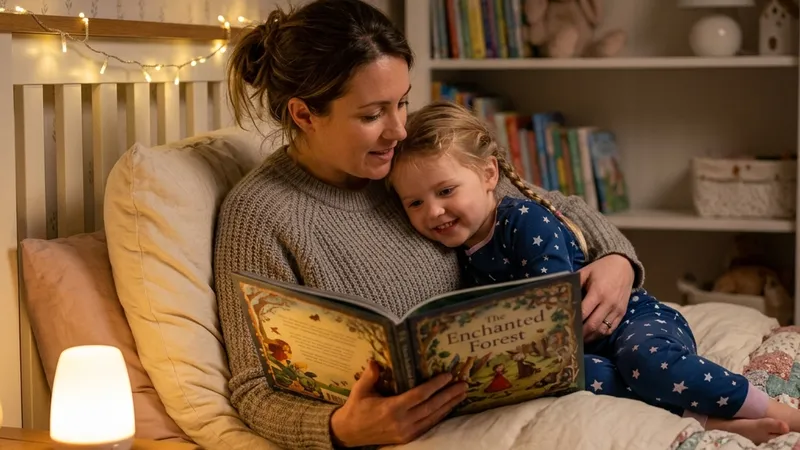
Reading bedtime stories is one of the most universally cherished parenting rituals. However, most parents default to a passive reading style: the parent reads the text on the page from start to finish, and the child sits silently and listens. While this traditional method is comforting and excellent for creating a positive bedtime ritual, you can literally double the cognitive and developmental benefits of storytime by transforming it from a monologue into an interactive dialogue.
When you invite your child to actively participate in the narrative, you stop merely entertaining them and start actively wiring their brain for advanced language processing, critical thinking, and boundless imagination. Here is a guide on how you can implement interactive storytelling techniques tonight, curated by our pedagogical storytelling assistant Düşle.
The Shift from Passive Listening to Active Engagement
When a child passively listens to a story, their brain is primarily absorbing information. They hear the vocabulary, they see the pictures, and they follow the plot. This is good, but it is a one-way street.
Active engagement, scientifically known as “dialogic reading,” turns the child into the storyteller. In dialogic reading, the parent acts more like a guide or a conversation partner rather than a narrator. The adult prompts the child with questions, expands on the child’s answers, and encourages the child to relate the story to their own lived experiences. This two-way interaction forces the child’s brain to switch from passive reception to active generation. They have to recall words, structure grammar, infer character motivations, and articulate their own thoughts aloud. It is a full mental workout disguised as a cozy bedtime cuddle.
Step-by-Step Solution: Techniques for Interactive Storytelling
You do not need to be a professional educator to practice interactive reading. You simply need to pause more often. Here are four specific techniques you can start using immediately.
Step 1: Dialogic Reading and Open-Ended Questions
The most fundamental interactive technique is pausing to ask questions that cannot be answered with a simple “yes” or “no.”
- The Application: If you are reading a book about a squirrel who lost his acorns, do not just read the words. Point to the illustration and ask, “Look at the squirrel’s face. How do you think he feels right now?” or “What do you think is hiding behind that heavy oak door?” This forces the child to analyze visual cues, construct complete sentences, and practice the pedagogy in storytelling by identifying complex emotions.
Step 2: The “What Happens Next?” Prediction Method
Before you turn the page at a critical moment in the plot, stop and ask your child to predict the future.
- The Application: Ask, “The bear just found a map in the cave. Where do you think the map leads?” or “Oh no, the bridge is broken! How do you think the rabbit is going to get across the river?” This exercise stimulates logic, cause-and-effect reasoning, and narrative structure comprehension. Even if their prediction is wildly incorrect (e.g., “The rabbit will build a rocket ship!”), validate their creativity.
Step 3: Practicing Echo Reading
For toddlers who are just beginning to speak in sentences, echo reading is a fantastic vocabulary builder.
- The Application: Read a short, rhythmic sentence, and then ask the child to repeat a key phrase back to you with the same emotion. If the book says, “The giant giant stomped his huge, heavy boots,” have the child echo “huge, heavy boots” while pretending to stomp their hands on the blanket. Connecting the physical action to the new vocabulary words cements the meaning of the words in their long-term memory.

Step 4: Exploring Alternative Endings
Once the story is completely finished and the book is closed, keep the dialogue going for just two more minutes by exploring alternative realities.
- The Application: Ask, “If you were the main character, how would you have solved that problem differently?” or “What do you think happened to the dragon after he went back to his mountain?” This exercise builds creative problem-solving skills, allowing children to think outside the literal boundaries of the text and realize that problems often have multiple viable solutions.
The Cognitive Benefits: Why Interactivity Matters
The benefits of dialogic reading are incredibly well-documented in developmental psychology.
- Vocabulary Expansion: When parents expand on a child’s answer (e.g., Child: “The dog is big.” Parent: “Yes, the dog is gigantic and fluffy!”), the child learns descriptive adjectives rapidly.
- Reading Comprehension: By constantly predicting outcomes and analyzing characters, the child learns how a story works. When they eventually learn to read text independently in elementary school, they will already possess advanced reading comprehension skills because they know how to look for context clues.
- Confidence Building: When a parent listens intently to a child’s wildly imaginative alternate ending and says, “Wow, that is a brilliant idea,” it builds immense intellectual confidence. The child learns that their ideas are valuable and worth sharing.
Prevention: Avoiding the “Interrogation” Trap
While interactive reading is powerful, there is a fine line between engaging a child and interrogating them. A common mistake eager parents make is peppering the child with too many rapid-fire, factual questions: “What color is the car? How many apples are in the tree? What did the cat say?”
If you ask too many testing questions, the child will feel like they are taking a pop quiz. The bedtime story will become stressful, and they will start resisting the routine entirely.
To prevent this, ensure that your questions are primarily open-ended and focused on feelings or imagination rather than facts. For every question you ask, make sure you also offer a personal observation. Say, “I love the color of the sky on this page, it looks like strawberry ice cream. What does it look like to you?” Keep the tone light, conversational, and completely free of judgment. If they don’t want to answer a question, cheerfully supply an answer yourself and keep reading.
When to Seek More Help or Watch for Edge Cases
Interactive reading is an excellent way for parents to informally monitor their child’s language development. If you consistently ask your three-year-old open-ended questions about a story and they consistently respond only with pointing, grunting, or single, disjointed words, it may warrant a discussion with a pediatrician.
While every child develops at their own pace, a significant lack of expressive language (the ability to form short sentences to express thoughts) or receptive language (the ability to understand the question you asked) by age three can be an indicator of an underlying speech delay or auditory processing issue. Early intervention with a pediatric speech-language pathologist is highly effective, and they often use these exact interactive storytelling techniques as part of their formal therapy.
Quick Summary
- Switch from passive to active: Treat the bedtime story as a two-way conversation rather than a one-way monologue.
- Use dialogic reading: Pause frequently to ask open-ended questions about character feelings and motivations.
- Encourage predictions: Stop before turning the page and ask the child to guess what will happen next to build logic skills.
- Discuss alternate endings: After the book closes, ask the child how they would have solved the story’s main conflict.
- Don’t interrogate: Avoid rapid-fire factual questions (like counting objects) that make the child feel tested and stressed.
- Monitor language milestones: Use this interactive time to casually observe if your child is hitting age-appropriate speech milestones.
Frequently Asked Questions
Will asking questions wake my child up and ruin bedtime?
If you ask highly stimulating, loud questions, yes. The key is to keep your voice low, slow, and soothing. Make the interaction feel like a cozy, sleepy conversation rather than an energetic daytime game. If they are clearly fighting to keep their eyes open, drop the questions and just read normally.
What if my child gives a completely nonsensical answer to my question?
Validate it enthusiastically! If you ask, “Where is the rabbit going?” and they answer, “To the moon to eat cheese,” reply with, “Wow, a cheese moon! That sounds delicious. Let’s turn the page and see if he goes to the moon or somewhere else.” The goal is imagination, not factual accuracy.
Is interactive reading only for toddlers?
Absolutely not. You can use dialogic reading with infants by pointing to pictures and naming them, and you can use it with older elementary children by discussing complex moral dilemmas faced by the characters in chapter books. The technique simply scales with the child’s cognitive ability.
Should I correct my child’s grammar when they answer my questions?
Do not explicitly correct them, as this causes embarrassment and discourages them from speaking up. Instead, use “recasting.” If they say, “The dog runned fast,” you simply reply warmly, “Yes, the dog ran so fast!” You are providing the correct grammatical model without making them feel corrected.
Can I do interactive storytelling if I am just making a story up from my head?
Yes, this is often the best time to be interactive! If you are inventing a story in the dark without a book, you can literally pause and let the child dictate the plot: “The knight reached a fork in the road. Should he go into the dark cave or the shiny castle? You decide!”
Create Personalized Magic with Düşle!
Want to generate stories tailored to your child’s interests and emotional milestones? Download the Düşle app. Let our pedagogical AI create bedtime stories that teach and comfort. Download Düşle App Now and start reading!